The machine, from every angle
This is the whole inspection station — the real assembly, not an artist's impression. Drag it around, zoom in, and open any marker to read what that part does.
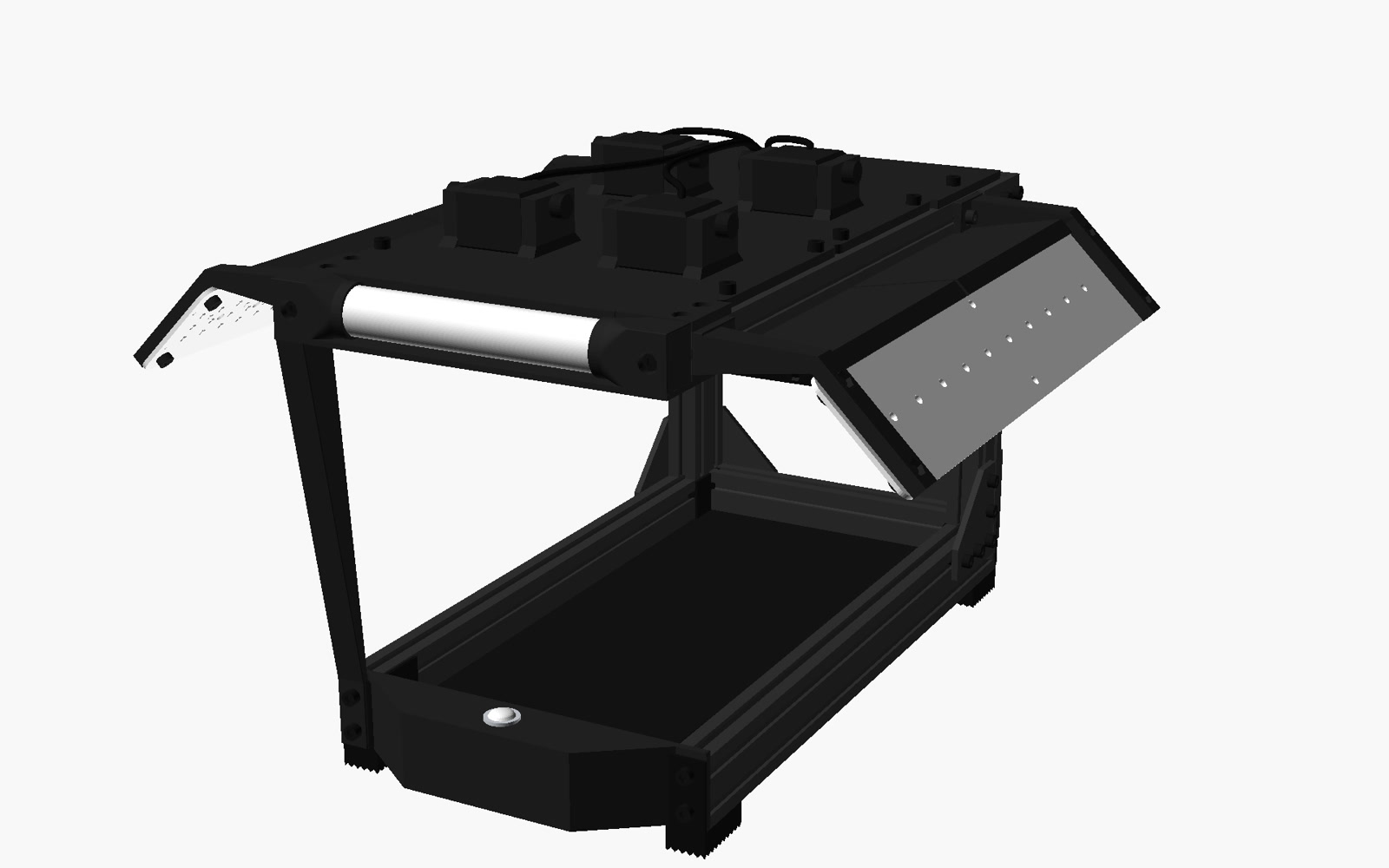
Drag to turn the machine. Scroll or pinch to zoom. Choose a marker to read about a part and fly the camera to it.
What you are looking at
Every marker on the model opens one of these. They are here as text too, because a specification is worth reading whether or not your browser feels like running a 3D canvas today.
- 65-megapixel camera array
- Four 16-megapixel cameras look straight down at the panel and are calibrated into a single 65-megapixel composite, so a whole board is captured in one shot. Nothing moves while it happens — there is no gantry to travel, no motion blur, and no mechanical drift between the first board of a shift and the last.
- Lighting built for PCBs
- Two custom illumination boards carry 132 individually positioned LEDs, angled in at 45° from both sides. That geometry lights every component evenly while keeping specular glare off glossy solder mask and shiny joints out of the lens — exactly what defeats an ordinary ring light. The boards are aluminium-clad, so they run cool enough to sit inches from a board all shift.
- Verdict you can read across the room
- A diffuser strip along the front edge reports the last inspection at a glance: white while idle, green on a pass, red on a fail. It sits at eye level on the front supports, so an operator reads the result from the other side of the bench instead of walking over to a screen.
- One button to run
- A single 16 mm pushbutton is the whole operator interface. Load a board into its fixture, press once, and the button lights with the result — white while idle, green on a pass, red on a fail. There is no parameter to tune and no training course to sit through.
- The working end
- A printed front panel closes off the end of the station the operator stands at and puts the start button under their thumb. The brushed silver label above it is the one bright detail on an otherwise matte black machine — which is deliberate, because everything else in the frame is there to absorb light rather than throw it back at the lenses.
- All the electronics in one box
- Everything electrical lives in a single sealed printed enclosure at the back: the controller board, the LED drivers and the camera hub. One cable leaves it for the host PC, and nothing is exposed where boards are handled. There is nothing to wire up on the bench.
Built to be unremarkable to operate
There is one control on the machine and one cable out of the back of it. Everything that makes inspection hard — the calibration, the lighting geometry, the fixture that holds a board in a known position — is settled before the station reaches your bench, and stays settled because nothing in it moves.
See it run on your boards
The quickest way to judge whether this fits your line is to watch it inspect something you built. Send us a board and we will show you what it sees.
Request a DemoOr email us directly at sales@pcbguard.com.
© 2026 Shepherd Vision LLC. All rights reserved.