PCB Guard
AI-Based PCB Inspection Station
Catch assembly defects in seconds — without the cost, the floor space, or the specialist operator that traditional AOI demands.
Inspect in Seconds
Place a board and press one button. A fixed camera array captures the whole panel at once — no gantry, no moving parts, nothing to wear out or drift out of alignment. Every board is inspected the same way, every time, with no operator judgment in the loop.
Set Up in an Afternoon
Upload your gerbers and the Fixture Wizard builds a 3D-printable fixture matched to your board, plus the inspection program that goes with it. No machining, no custom tooling, no six-week lead time before you can inspect anything.
Own Every Record
PCB Guard runs entirely offline. Images, barcodes and results are written to your own disk or network share, organized by part number and serial. No cloud subscription, no per-seat fees, and no production data leaving your building.
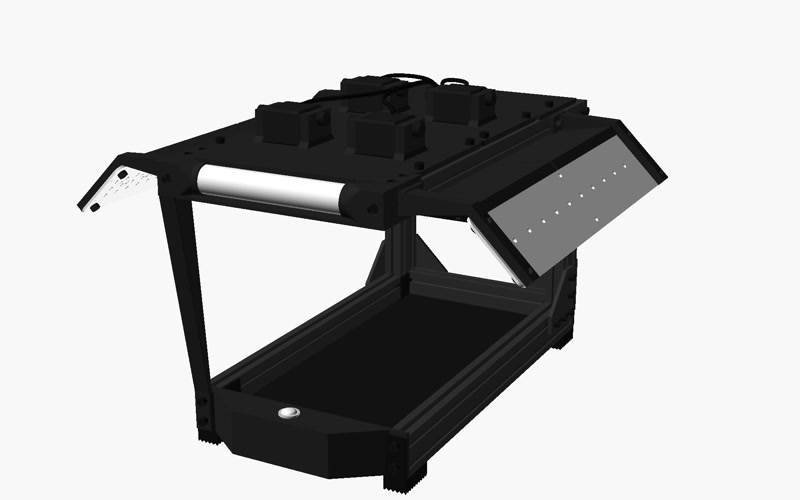
See the machine in 3D
The whole inspection station, in your browser. Turn it, zoom in, and open any part to find out what it does and why it is shaped that way.
From gerbers to inspected boards
Four steps. No machining, no tooling order, no vision engineer.
Upload your gerbers
The Fixture Wizard renders your board in 3D and generates a fixture that holds it in a known, repeatable position.
Print the fixture
Print on any FDM printer — ideally in conductive filament for ESD safety. Drop it in and the board is aligned.
Teach it a good board
Run a known-good board. PCB Guard learns what correct looks like from your product — no rule-writing, no scripting.
Press start
Operators load a board and press one button. Pass or fail in seconds, with every image and result logged automatically.
A 65-Megapixel Camera Array
Four high-resolution cameras are calibrated and combined into a single composite image, resolving fine-pitch components and small passives across the entire scan area. Because the array is fixed, there is no gantry to move, no motion blur, and no mechanical drift between the first board of the shift and the last.
Lighting Built for Solder
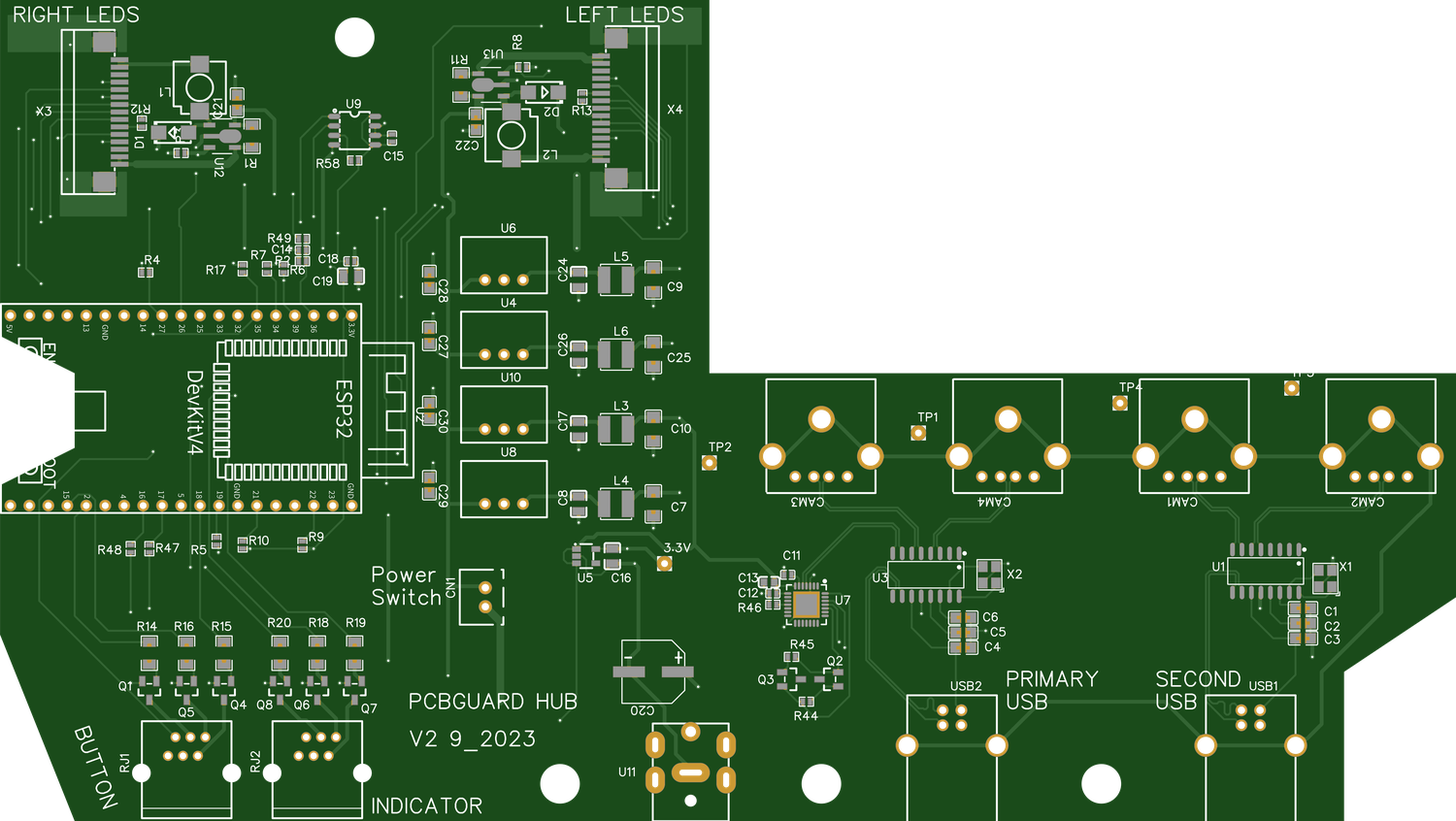
Glossy solder mask and shiny joints defeat ordinary ring lights — they throw specular glare straight back into the lens and wash out exactly the detail you need. PCB Guard uses 132 individually positioned LEDs across two custom illumination boards, angled to light every component evenly while keeping direct reflection out of the optical path.
Fixtures From Your Gerbers
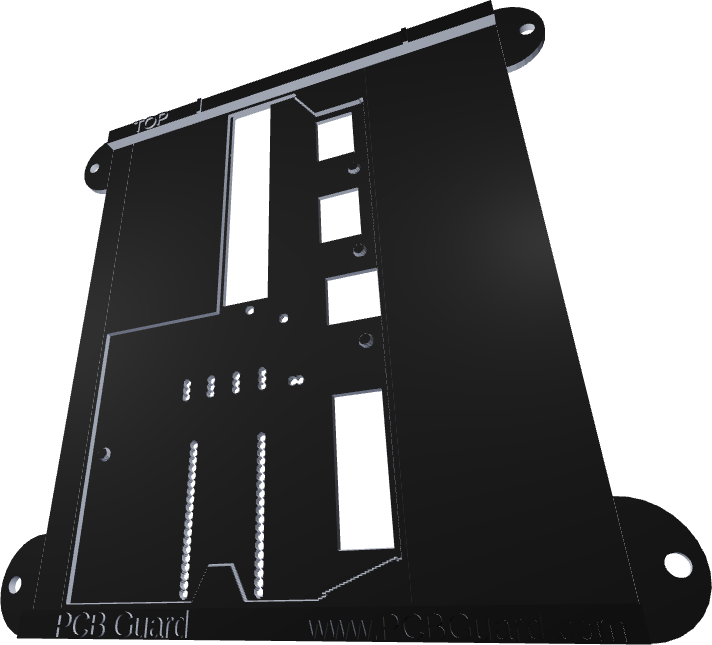
Upload your gerber files to the Fixture Wizard. It renders the board, generates a 3D-printable fixture matched to its outline and mounting holes, and produces the fixture file that tells the software where every board sits. Conventional AOI tooling costs thousands and takes weeks to arrive. This costs filament and takes an afternoon.
An AI Trained on Your Boards
PCB Guard learns from your product, not from a generic defect library that has never seen your assembly. Show it boards that passed and boards that failed, and it learns the difference — missing components, wrong parts, tombstones, misorientation, bad solder. No PhD, no vision engineer on retainer, no scripting language to learn.
One Button to Run
The operator interface is a single start button and a colored indicator on top of the machine. Green passes, red stops the board. There is no training course, no parameter tuning and no specialist operator — if someone can load a board into a fixture, they can run inspection on their first shift.
Every Board on the Record
Every inspection writes a full-resolution image, the decoded barcode or Data Matrix, any verified text, and a pass or fail verdict with the reason it was reached. Records are organized by part number and serial and stay on your hardware. When a customer asks about a board you shipped last quarter, you have the picture.
Fast Enough for the Line
The inspection pipeline is built on parallel GPU processing rather than conventional single-threaded image analysis, which makes it dramatically faster than the CPU pipelines most inspection software still relies on. Inspection keeps pace with assembly instead of becoming the station everything queues behind.
Specifications
| Scan volume | 12 × 7 × 1 in (305 × 178 × 25 mm) |
|---|---|
| Camera array | 4 × 16.3 MP (4656 × 3496), ~65 MP composite |
| Illumination | 132 individually positioned LEDs, flash synchronized |
| Moving parts | None |
| Inspection | Component presence, image comparison, barcode & Data Matrix, OCR |
| Board support | Single boards or multi-up panels |
| Fixtures | 3D printed from your gerber files |
| Data storage | Local disk or network share — JSON result plus full-resolution image per board |
| Connectivity | Fully offline capable; no cloud service required |
Why teams bring it in
A fraction of the cost of conventional AOI
Traditional inspection systems are a capital purchase with a tooling bill attached to every new product. PCB Guard is built from a fixed camera array and printed fixtures, which takes the expensive, moving, wearing parts out of the equation entirely.
No tooling lead time
New product on Monday, inspecting it on Tuesday. The fixture comes off your own printer, generated from the gerber files you already have.
No specialist operator
One button and a colored light. Inspection stops depending on which technician is on shift and how carefully they looked.
Traceability you actually keep
A photograph and a verdict for every board you build, stored on your own hardware, searchable by part number and serial.
See it run on your boards
PCB Guard is being rolled out with a small group of early users, and we are looking for a few more manufacturers to test it against real production work. If you build electronics and inspection is a bottleneck — or you are still doing it under a microscope — we would like to talk.
Request a DemoOr email us directly at sales@pcbguard.com.
© 2026 Shepherd Vision LLC. All rights reserved.